Meet Tushar Krishnan: Backing India's Deep Tech Moment
Meet Tushar Krishnan: Backing India's Deep Tech Moment
Celesta Capital is pleased to welcome Tushar Krishnan as an Associate on our India team in Bangalore. Tushar arrives with a background that covers each stage of how a deep technology becomes a business: biotechnology at IIT Guwahati, biomedical engineering at Duke, diagnostics research, years commercializing surgical imaging at Leica Microsystems, and a Stanford MBA that turned him toward venture. He returned to India convinced that its deep tech ecosystem had reached an inflection point. We spoke with Tushar about the gap between a working technology and a working business, what he looks for in founders, and why he believes the ingredients for India's deep tech moment are now in place.
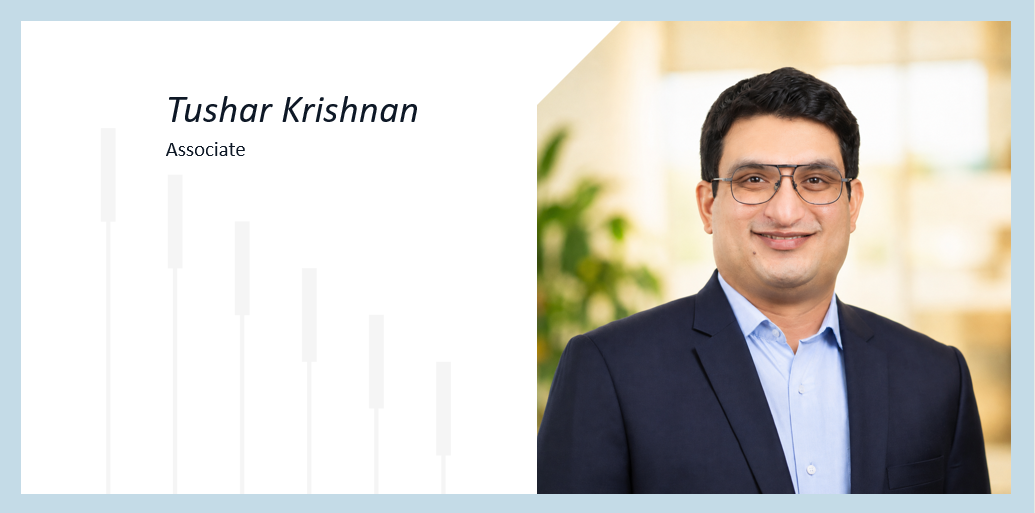
Celesta Capital is pleased to welcome Tushar Krishnan as an Associate on our India team in Bangalore. Tushar arrives with a background that covers each stage of how a deep technology becomes a business: biotechnology at IIT Guwahati, biomedical engineering at Duke, diagnostics research, years commercializing surgical imaging at Leica Microsystems, and a Stanford MBA that turned him toward venture. He returned to India convinced that its deep tech ecosystem had reached an inflection point. We spoke with Tushar about the gap between a working technology and a working business, what he looks for in founders, and why he believes the ingredients for India's deep tech moment are now in place.
Your path runs from IIT Guwahati to Duke, Leica, and Stanford. How did one step lead to the next?
I grew up in India and did my undergraduate degree in biotechnology at IIT Guwahati, where I got my foundational training in engineering biological systems into useful products. I wanted to understand how those technologies are built, so I went to Duke for a master's in biomedical engineering focused on medical devices, and I stayed on in research there, working on a point-of-care diagnostic platform.
In that period I realized that technology is only one part of the puzzle. You have to understand commercialization as well. After some years in industry, I came back to the U.S. for my MBA at Stanford, where I got acquainted with the venture and founder ecosystems and could see that India's deep tech ecosystem was burgeoning. That's what brought me back.
You were an operator at Leica Microsystems before moving to venture. Is there a moment from that time you're most proud of?
At Leica we were working on a product that performed well in lab settings but wasn't solving what the customer needed, and the customers were surgeons. I was new there, but at Duke I had worked a lot with surgeons and doctors at the hospital, and I could draw on that. I went to the site, got hands-on with the surgeons, and worked to understand what their problem was, then worked with our engineering team on what the solution could be. Over multiple iterations of that cycle we came out with a much improved product that helped surgeons in their work. That felt fulfilling.
What pulled you from operating to investing?
At Stanford I was talking to people at different points in their entrepreneurial journeys, and most of them were trying to solve similar problems, the same ones I had run into in academia at Duke and as an operator at Leica. So I asked whether I could use both sides of that experience, the technical understanding and the operating lessons, to add value to technologies other people were building.
I tested that with the Stanford High Impact Technology Fund, an early-stage fund that gives university labs initial money and commercialization help through MBA interns. Working with one of those teams on how to de-risk their technology and which commercial milestones to aim for, I realized there was a lot I could offer.
What drew you to join Celesta?
The first thing was Celesta's ethos. The firm is IP-led and grounded in scientific discovery, and it sets out to create generational companies with long-term impact rather than riding the current wave. Many of these technologies never get the support they need along the way, and Celesta has a long record of standing behind its portfolio through thick and thin.
The second was the firm's discipline around loss ratio. If you invest in a company, you want to see it succeed, and that's what Celesta does, with the might of the whole firm and all hands on deck. The third was Celesta's pioneering role in India's deep tech ecosystem, through the India Deep Tech Alliance and the investments already made here. I knew I could learn from the founding partners and the partners on the India fund, and draw on that understanding to help Indian founders.
What's the focus of your role on the India team?
There are a lot of deep tech companies in India right now, because of policy tailwinds and because of the strong engineering talent that was already here. What's missing is the bridge between developing a technology and making sure it has a market. My role here is to bridge that gap: to make sure these technologies get the right guidance at the right points in time, so they can become successful companies.
What's missing is the bridge between developing a technology and making sure it has a market. My role here is to bridge that gap.
With the India Semiconductor Mission, the IndiaAI Mission, and the RDI scheme all in motion, how do you see the potential for deep tech in India?
The potential is enormous, and it's heartening to see. The research ecosystem today is a huge change from the one I knew as an undergraduate. There is a focus on an entrepreneurial mindset right from the start, so students are incubated in that way of thinking in their first year. Then there's the policy push, which is giving deep tech companies the infrastructure and financial support they need while the technology is still being developed.
All of this has created awareness among investors in India and abroad, which matters because deep tech needs patient capital. The early stages are now funded, but these companies also need a lot of investment at the growth stage, whether that's human, intellectual, or financial capital. All the ingredients are in place for India's deep tech ecosystem to take on the world. It's a matter of time.
When you evaluate a deep tech startup's commercial potential, what are you looking for?
It starts with the technology. How differentiated is it? You want technologies that can stand the test of time, hold up through the waves that come along, and compete globally. Then, from an IP perspective, how defensible and enforceable is the IP around that differentiation?
The second question is whether you're solving a real problem. Founders can get so deep in developing the technology that they miss whether it will be useful. Sometimes you set out toward one use case and realize along the way that the technology suits something else. Bubble wrap started out as a wallpaper. So I look for founders who are open to their technology going in directions they didn't plan.
Which sectors interest you most, including any that might be overlooked?
Bioconvergence, in all its aspects, is close to my background, and India has a lot of potential there: a manufacturing cost advantage, a tradition of frugal engineering, and for clinical trials, a genetic diversity that provides a data set you would struggle to assemble in most other places.
Physical AI is another, meaning AI plus robotics: an intelligence layer added to robots so they can carry out specific tasks. That intelligence will be specialized; the robot that handles a manufacturing task won't be the same robot that cleans your house. Space is the third. We're already invested in Agnikul Cosmos, which builds small satellite launch vehicles with its own 3D-printed semi-cryogenic engine, and the sector is growing because of policy tailwinds and because a sovereign India wants its own capabilities in place.
Beyond returns, is there a personal mission that brought you into this work?
It's the same reason I was drawn to biotech, biomedical engineering, and healthcare in the first place: seeing tangible results and how they affect people's lives. If you look through history, it's strong technologies that have marked the shifts forward for societies. Being part of that journey, and watching the companies we back go on to move society forward, is what I look forward to most.
Outside of work, what are you reading, and how do you spend your time?
I love playing tennis, so I play a lot. And I'm a huge trivia buff. I did competitive trivia in my school and college days in India, and I still go to trivia events here and there. It keeps me curious, which matters for an investor looking for new technologies.
Right now I'm reading Nexus by Yuval Noah Harari, on the history of information networks, how they've shaped societies, and what that history suggests about how AI will affect us.